
Artikelnummer
LXDVOTIC
Technique in Chess
176 Seiten, kartoniert, Russell Enterprises, 1. Auflage 2023
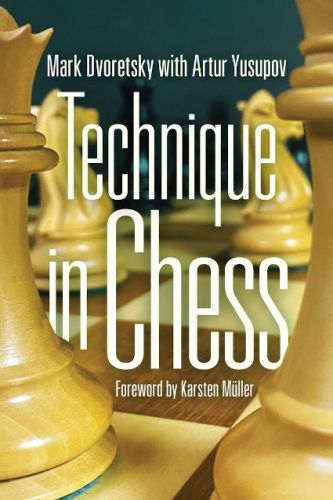
”And the Rest Is Just a Matter of Technique...“
How often has this comment been appended to a game move or variation? As many players know, it really may not be all that easy to figure out what is meant by this familiar phrase.
After the untimely passing of legendary instructor Mark Dvoretsky, Artur Yusupov was given access to Dvoretsky’s famous card files. With the core material based upon these files, the former top ten grandmaster and perhaps the most successful of all of Dvoretsky’s students put together this book, modifying and refining the content as needed.
The book begins with a ”theoretical“ explanatory section. This is followed by 102 practice positions, which increase in in difficulty. Good technique for gaining an advantage is useful in all areas of the game, so there are positions from the opening, middlegame, and especially the endgame not only from practical games but also from various studies.
The comments to the solutions are very detailed, explaining not only the main line but also the supplementary side variations. Yusupov thought it important to demonstrate the logic in the search for a decision and to show how a chessplayer can come to the right conclusions at the board.
Dvoretsky’s master student Artur Yusupov has done a great job in selecting and presenting the material so that this book ”feels“ like another genuine Dvoretsky work. This book is a real gem and I hope that it gives you as much pleasure as it has given me. And that from now on, when you have an advantage, the rest really will be, well, just a matter of technique… From the Foreword by Grandmaster Dr. Karsten Müller
How often has this comment been appended to a game move or variation? As many players know, it really may not be all that easy to figure out what is meant by this familiar phrase.
After the untimely passing of legendary instructor Mark Dvoretsky, Artur Yusupov was given access to Dvoretsky’s famous card files. With the core material based upon these files, the former top ten grandmaster and perhaps the most successful of all of Dvoretsky’s students put together this book, modifying and refining the content as needed.
The book begins with a ”theoretical“ explanatory section. This is followed by 102 practice positions, which increase in in difficulty. Good technique for gaining an advantage is useful in all areas of the game, so there are positions from the opening, middlegame, and especially the endgame not only from practical games but also from various studies.
The comments to the solutions are very detailed, explaining not only the main line but also the supplementary side variations. Yusupov thought it important to demonstrate the logic in the search for a decision and to show how a chessplayer can come to the right conclusions at the board.
Dvoretsky’s master student Artur Yusupov has done a great job in selecting and presenting the material so that this book ”feels“ like another genuine Dvoretsky work. This book is a real gem and I hope that it gives you as much pleasure as it has given me. And that from now on, when you have an advantage, the rest really will be, well, just a matter of technique… From the Foreword by Grandmaster Dr. Karsten Müller
| EAN | 9781949859645 |
|---|---|
| Gewicht | 350 g |
| Hersteller | Russell Enterprises |
| Medium | Buch |
| Erscheinungsjahr | 2023 |
| Autor | Artur JussupowMark Dworetski |
| Sprache | Englisch |
| Auflage | 1 |
| ISBN-13 | 978-1-949859-64-5 |
| Seiten | 176 |
| Einband | kartoniert |
| Name | Russell Enterprises |
|---|---|
| Adresse | 234 Depot Road Milford, CT 06460 USA |
| Internet | www.Russell-Enterprises.com |
| hwr@russell-enterprises.com |
Verantwortlicher Importeuer:
| Name | Schachversand Niggemann |
|---|---|
| Adresse | Schadowstraße 5 48163 Münster Deutschland |
| info@schachversand.de | |
| Internet | www.schachversand.de |
006 Preface
008 Foreword
Part I
011 The Concept of Technique
011 Endgame Technique and Realizing an Advantage
012 A Player’s Behavior in Better Positions
012 Full Concentration
013 Time Management
020 Realizing a Material Advantage
023 General Principles of the Endgame
026 Realizing an Advantage in the Endgame
027 Realizing a Positional Advantage and the Four Golden Principles of Technique
028 Do Not Allow Counterplay!
030 Do Not Hurry!
032 The Principle of Two Weaknesses
034 Correct Exchanging
037 The Transformation of an Advantage
038 Concrete Play in Realizing an Advantage
041 Part II
041 Exercises
059 Solutions
170 Index of Endgame Composers
171 Index of Players
174 Recommended Books on the Endgame and Endgame Technique
176 Signs & Symbols
008 Foreword
Part I
011 The Concept of Technique
011 Endgame Technique and Realizing an Advantage
012 A Player’s Behavior in Better Positions
012 Full Concentration
013 Time Management
020 Realizing a Material Advantage
023 General Principles of the Endgame
026 Realizing an Advantage in the Endgame
027 Realizing a Positional Advantage and the Four Golden Principles of Technique
028 Do Not Allow Counterplay!
030 Do Not Hurry!
032 The Principle of Two Weaknesses
034 Correct Exchanging
037 The Transformation of an Advantage
038 Concrete Play in Realizing an Advantage
041 Part II
041 Exercises
059 Solutions
170 Index of Endgame Composers
171 Index of Players
174 Recommended Books on the Endgame and Endgame Technique
176 Signs & Symbols
Mehr von Russell Enterprises
-
 Dvoretsky's Endgame Manual34,50 €
 -
 Dvoretsky's Analytical Manual32,95 €
 -
 Edgard Colle12,95 €
 -
 DRAW!14,95 €
 - Mehr von Russell Enterprises